Hey all, and welcome to the second Expedition Log! This time, we’ll be talking about possibly the most important political entity in shaping medieval Antarctica: The Shariphate.
While it -basically- no longer exists, the Shariphate was a massive political force, stretching from the island of Dasqus in the south, all the way up the Altasian Mountains to the Zhargon peninsula in the north, along with having conquered all of Mevotamia across the Navel Sea. I realize thats a mouthful for those without a good grasp of the world, so here’s a reference:
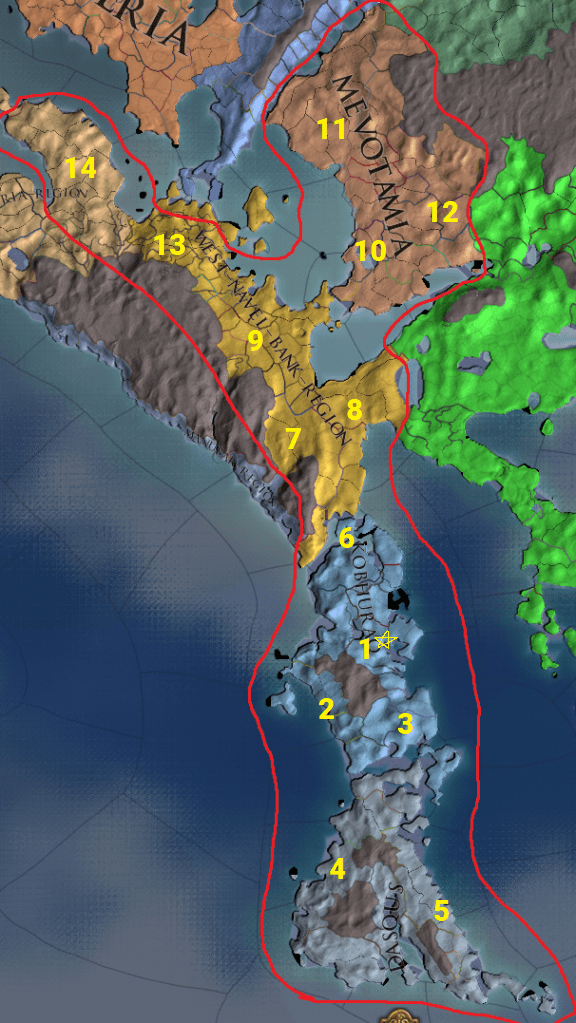
Pretty successful, to say the least!
Along with their conquest, the Shariphate brought their culture, but more importantly their religion: the Sharyi faith. The faith itself inspired the creation of the Shariphate state, converting many from their polytheistic religion in the surrounding region in it’s early days. This led to a powerful caste of holy warriors, which formed the backbone of the Shariphate army and played a big part in it’s early military success.
Before I keep going, I should state the obvious; yes, this state and it’s corresponding religion are inspired by/based off of the Caliphate and Islam in OTL.
Below is the basic history of the Shariphate’s expansion. Theres a lot to cover, so details will be left for later Logs:
- The religion came to being at the holy city/imperial capital of Khelej (denoted by a star), and the surrounding region was quickly dominated and assimilated.
- The Bhuqi tribespeople begun converting and bolstering the Shariphate’s ranks. Interestingly, the region was only formerly integrated into the Shariphate much later after the majority of conquests were finished. This is because the region is incredibly arid and tribal with coastal deserts and mountains, making it’s governance not immediately worth it.
- The kingdoms of Simedinia were conquered next
- The land of the Ghimeyans (5) was incredibly valuable, but a defensive coalition was formed, making conquest of the land difficult. Thus, campaigns were waged in the land of the Oqugiri (4). Many of the Oqugiri kings converted, as many coveted the lands of Ghimeya, and resented how their people were essentially exploited to work in mines or as mercenaries. Eventually, all of Oqugria was under the leadership of local kings, who swore loyalty to the Shariphate
- With Oqugria secured, the allied forces descended on Ghimeya. The coalition forces were unprepared for the onslaught, and were shattered after one battle. Cities then fell one-by-one and were completely ravaged.
Theres still much to cover with the history of this island, but the important bit is the fact that the isle of Dasqus is very separate from that of Khoburaq. Thus, it made sense to delegate it’s governance. This led to the creation of the first “Beylayet”, or regional governorship, which was given to the eldest son of the Shariph. This was monumental, as it established a precedent for all of the Shariph’s future conquests
Upon returning to Khelej before venturing further north, the declared himself as Beylayet of Khoburaq, officiating his direct rule over the rest of the island.
The next target of conquest was the kingdom of Jezzebell (6). In truth, I don’t have much content idea for them quite yet, but I do know they were once a strong, and the southernmost Chazhuranic kingdom. Perhaps after it’s conquest it assimilated very hard, explaining why it is in the shaqri culture group, and it’s provinces follow the sharyi faith? I’m not quite sure what route I want to take this area.
Next target after Jezzebell was the kingdom of Zejmedem (7), centered around the Chazhuranic holy city of Yammadaj. The kingdom was quite resilient and managed to repel the shariphate, but it’s eventual capitulation was inevitable. Thus, the Shariphate came to an agreement to subjugate them, rather than annex them and distribute their land to Beylayets.
Next, were the Kashmigiri princes (8). The region was quickly annexed, and the Beylayet of Salgha was established. Salgha was vital, as it was rich, and a vital region for controlling trade. The successes in this region led to overconfidence on the part of the Shariphate, and they attempted to push further east. However, many of the princes and generals who lost their realms to the Shariphate had already fled east, and a coalition had assembled. With such strong, and prepared forces, the Shariphate had met their match, and were initially pushed back before a stalemate was reached, and peace was subsequently signed.
This left Salgha in a slightly dangerous position, as it needed to maintain a large army to keep Zejmedem in line, to deter the now-hostile kingdoms to the east, to protect the flow of trade through the region, and later, to keep the Shariphate contiguous as it continues to expand north.
At this point, I think its best if I list out their remaining conquests in bullet form:
- The Kingdom of Zeweh and Bunukulti (9), where the beylayet of Al-Yuruq was established
- The kingdom of Sabybria (10) capitulated after one battle where their king was slain, while Hayametchia (12) fought on for quite a while before being completely subjugated. From their ashes, the beylayet of Al-Qaumeziya
- The kingdom of Izbizia (11) proved a worthy foe, and war waged between them and the Shariphate for years, until a brilliant tactician on the side of the Shariphate won multiple successive battles and won the war. In his honor, Al-Wuram was established
- The Tupatzi kingdoms were all eliminated, and Al-Zayyaq was established.
However, it is at this point that things slowed to a halt for the Shariphate, as they had no more avenues for easy expansion. This is particularly due to the establishment of the Holy Patzerian Confederation in the north, which would come to the aid of nearby Salorium realms in need and deflect their advances. This occurred first in the defense of Haklivitea, on the northern coast of Al-Zayyaq.
This lack of expansion paths lead to a sudden decline in martial culture within the Shariphate, and then high amounts of autonomy within each of the Beylayets. But thats enough for this blog post: in the next, I will cover the future of the Shariphate, and the many factors that led to it’s collapse.
 Graapefruit.com